
Running a memorable gathering means keeping every attendee safe from unexpected health emergencies. Managing site logistics and crowd dynamics requires a rigorous medical risk assessment for events to protect lives, prevent delays, and maintain full compliance with local emergency regulations.
Why a Medical Risk Assessment for Events Is Necessary
Think of health planning like an invisible safety net at a circus. Without a proper medical risk assessment for events, one minor slip can turn your dream festival into a chaotic nightmare fast. Securing proper medical coverage keeps your party pumping safely and protects your reputation!
Core Evaluation Factors in Medical Safety
A robust safety framework relies on evaluating specific baseline metrics to build targeted defense mechanisms before doors open.
Analyzing Crowd Demographics and Vulnerabilities
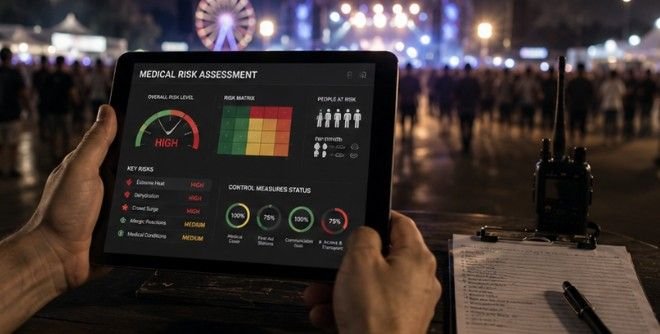
Every crowd brings a distinct medical footprint based on age, mobility, and historical health data. Older demographics attending classic music showcases carry higher statistical risks for cardiovascular events or mobility-related falls. Conversely, youth-oriented sporting tournaments frequently encounter dynamic acute trauma, heat exhaustion, and dehydration.
Evaluating expected participant numbers alongside vulnerable populations lets planners customize their clinical capabilities. Historical injury rates from past gatherings provide baseline projections for required supplies like splints or cardiac equipment. Identifying these unique demographic trends ensures medical teams are equipped for specific real-world emergencies.
Evaluating Environmental and Physical Conditions
Site geography and weather forecasts directly dictate your daily operational stress levels. Extreme heat waves rapid-fire dehydration cases into your medical tent, while freezing rain causes widespread hypothermia and slipping hazards. Outdoor open-air venues demand continuous weather monitoring and dedicated shelter zones for rapid heat relief.
Indoor venue layouts require careful mapping of structural bottlenecks, stairwells, and emergency exits. Tight physical corridors slow down medical extraction teams trying to reach collapsed attendees inside packed crowd centers. Evaluating site terrain and indoor layout limits guarantees seamless access during urgent response operations.
Substance Usage Patterns and Crowd Behavior
Anticipating substance consumption is critical when designing on-site treatment capabilities. Events serving high volumes of alcohol routinely see elevated rates of physical trauma, acute intoxication, and aggressive behavior. Music festivals with young crowds often require specialized care zones for polysubstance overconsumption and anxiety attacks.
Establishing specialized welfare spaces alongside formal medical stations prevents minor intoxication cases from overwhelming clinical personnel. Sedating intoxicated patients in quiet, monitored zones keeps main triage bays open for true medical crises. Proactive behavioral mapping keeps clinical resources focused where they are needed most.
Resource and Response Planning Blueprint
Translating initial evaluations into real-world protection requires structured deployment strategies and seamless emergency coordination.
Medical Staffing Ratios and Capabilities
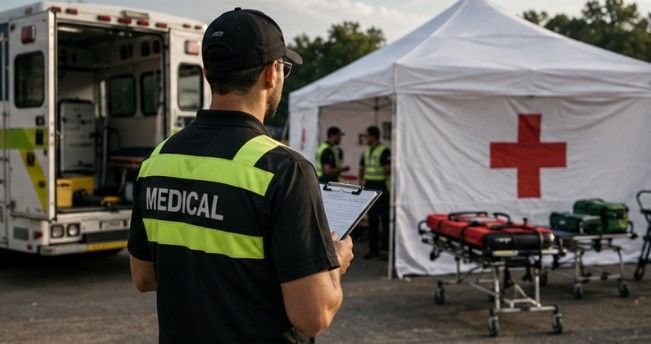
Calculating exact medical personnel depends on risk scoring models established by public health organizations. High-density crowds require a balanced mix of physicians, registered nurses, paramedics, and certified Emergency Medical Technicians (EMTs). Placing Advanced Life Support (ALS) capabilities on-site reduces heavy burdens on regional municipal health systems.
Response teams must be distributed strategically rather than remaining static inside main medical tents. Deploying foot patrols and mobile bike teams enables rapid medical arrival times under four minutes across large footprints. Maintaining flexible clinical staffing guarantees continuous care even during sudden crowd surges.
First-Aid Station Placement and Access Routes
Positioning first-aid stations requires balancing visible attendee access with clear ambulance egress corridors. Stations must feature prominent high-contrast signage, overhead lighting, and climate control to stabilize critical patients safely. Marking these points on digital event maps guides attendees directly without triggering secondary crowd choke points.
Ambulance loading zones must remain completely free from physical obstructions, vendor booths, and foot traffic. Establishing dedicated vehicle corridors allows private transport units to enter and exit without hitting venue traffic jams. Strategic station placement saves precious minutes during life-threatening emergency transports.
Local Hospital Integration and Communication
Establishing direct communication lines with regional emergency operations centers coordinates seamless hospital handoffs. Notifying nearby trauma centers about your event scope, expected crowd sizes, and specialized risks prevents sudden hospital ER surges. Shared radio frequencies ensure immediate coordination between on-site supervisors and city 911 dispatchers.
Integrating state or municipal emergency management standards guarantees full regulatory compliance across all operations. Utilizing recognized tools like the Risk Assessment Wizard or local council guidelines establishes strong legal defensibility for organizers. Unified interagency planning ensures your team acts as a cohesive extension of local emergency services.
How to Conduct a Medical Risk Assessment for Events
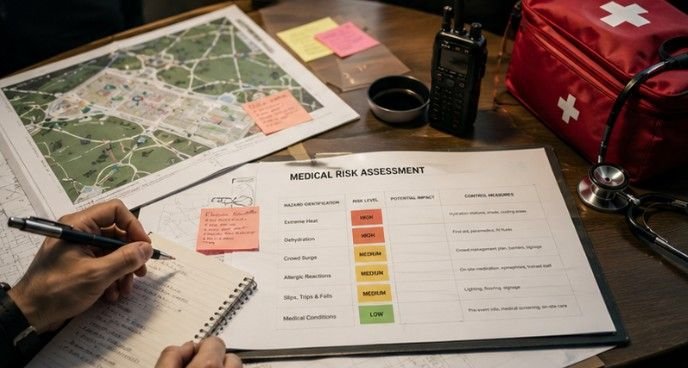
First, initiate a thorough walkthrough of the physical venue alongside local fire marshals and EMS leadership. Identify potential physical hazards, review emergency exit gates, and map out dedicated ambulance loading corridors. Checking physical entry points early ensures your transport routes remain completely clear during peak crowd congestion.
Second, gather crowd demographic projections, event duration details, and expected weather conditions to build a formal risk matrix. Calculate your required staffing ratios based on recognized guidelines like those published in the National Institutes of Health (NIH) literature. Position certified EMTs, paramedics, and first-aid supply hubs strategically near high-density operational zones.
Third, test all primary and secondary communication channels between on-site medical posts, private security, and municipal 911 dispatch. Review standardized triage protocols, such as the START method, to streamline care during unexpected mass casualty situations. Establishing clear escalation trees keeps every emergency worker aligned when critical seconds count.
Fourth, continuously monitor site operations throughout the gathering, making real-time adjustments as weather or crowd behavior shifts. Log every patient contact, minor treatment, and hospital transfer into secure medical databases immediately. Completing post-event documentation reviews refines future health strategies while satisfying insurance underwriters and city health inspectors.
Frequently Asked Questions
1. How to conduct a risk assessment for an event?
Identify physical hazards, analyze crowd demographics, calculate risk scores using severity and likelihood matrices, assign control measures, and regularly review plans with local emergency services.
2. What are the 5 things a risk assessment should include?
A thorough assessment must include explicit hazard identification, evaluation of affected populations, detailed risk control protocols, clear staff responsibility assignments, and formal documentation tracking operational reviews.
3. What are some examples of event risks?
Common examples include extreme weather exposures, severe crowd compression, foodborne illness outbreaks, structural equipment failures, excessive alcohol intoxication, and acute health emergencies like cardiac arrest.
4. What is the Generic All-hazards risk assessment Tool for Mass Gathering Events?
Developed by the World Health Organization alongside the Johns Hopkins Center for Health Security, this digital tool helps organizers evaluate public health vulnerabilities and emergency capacities for mass gatherings.
Lock in Safety and Party On With Confidence
Executing a professional medical risk assessment for events transforms scary operational uncertainties into a bulletproof safety plan. Prioritizing attendee wellbeing through expert staffing, hazard mapping, and interagency communication guarantees your gathering stays secure and fully compliant. Take charge of your site health planning early to deliver smooth, legendary events that keep everyone protected from start to finish!
Leave a Reply