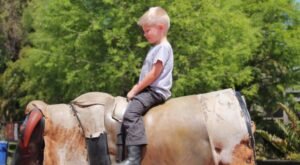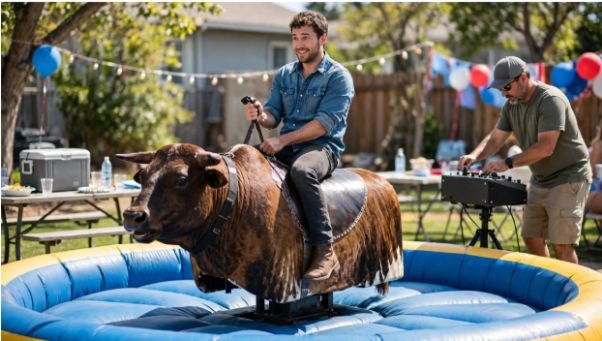

A five-year-old may meet one rental company’s age rule yet still be too short for its machine. A 275-pound adult may qualify on one bull but exceed another unit’s capacity. That is why mechanical bull age and weight requirements should never be reduced to one universal number.
After comparing manufacturer guidance, rental policies, insurance documents, and injury research, I found three limits matter most: age, height, and weight. The final decision should always rest with the trained operator following the specific ride manual.
The Typical Age, Height, and Weight Limits
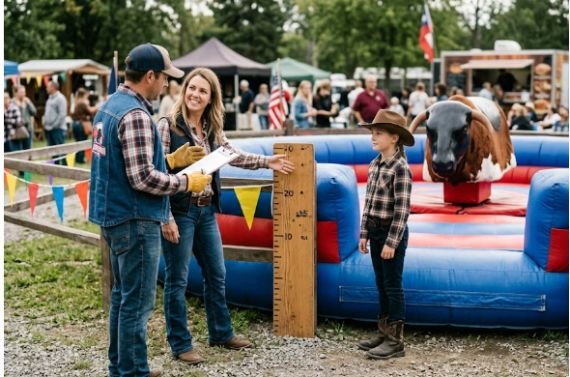
Many commercial rentals accept children from about five to eight years old. However, that range is only a common business policy. It is not a nationwide safety standard.
Full-size units often allow riders weighing up to 250 or 300 pounds. Smaller carnival or children’s units may have lower limits, sometimes between 150 and 200 pounds.
A widely used commercial mechanical bull manual recommends a minimum rider height of 48 inches and a maximum weight of 300 pounds. The same manual instructs riders to sit centrally, keep their legs back, and hold the rope with one hand.
Minimum Age Requirements
Some operators accept riders aged five or six. Others set the minimum at eight, ten, or even fifteen years. The difference may reflect the equipment, event type, insurer, or operator’s risk policy.
For example, one commercial event provider requires riders to be at least eight years old, four feet tall, and under 300 pounds. It also requires a rider or guardian waiver.
I would not advertise “ages five and up” without checking the actual booking agreement. A child’s age does not prove that they have enough height, coordination, grip, or confidence.
Maximum Rider Weight
A 300-pound limit appears in several commercial machine manuals, but it is not suitable for every bull. The listed number describes the capacity of that specific model.
Exceeding the approved weight can affect the motor, saddle, mounting system, inflatable base, and operator control. It can also breach the rental company’s insurance terms.
Hosts should never estimate a guest’s weight or pressure someone to disclose it publicly. The better approach is to display the limit clearly and let riders speak privately with the operator.
Why Height Can Matter More Than Age
Height determines whether a rider can straddle the body securely and position their legs correctly. A child may meet a minimum age but remain unable to grip the bull safely.
The 48-inch guideline appears in both manufacturer instructions and commercial rental policies. Still, hosts must treat it as model-specific guidance rather than a rule covering every machine.
This is why complete mechanical bull age and weight requirements should include height. Publishing only an age limit leaves an important suitability question unanswered.
Why Mechanical Bull Restrictions Vary
Mechanical bulls come in different sizes, designs, speeds, control systems, and landing-area configurations. A compact children’s unit cannot automatically follow the limits of a commercial adult model.
Manufacturer Specifications
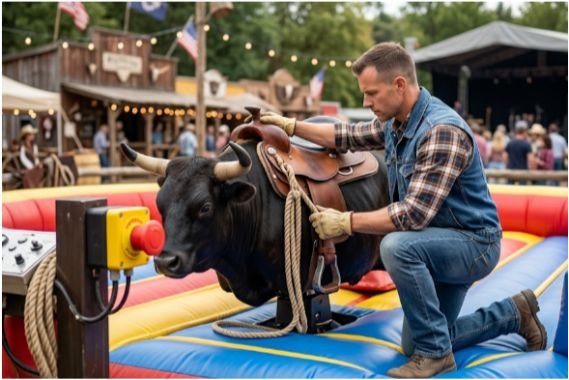
The manufacturer’s operating manual should be the first authority. It identifies the tested rider capacity, correct position, operating method, electrical needs, inspection duties, and emergency procedures.
A rental provider should be able to identify the bull model and explain its documented restrictions. Vague answers such as “it holds almost anyone” should raise concern.
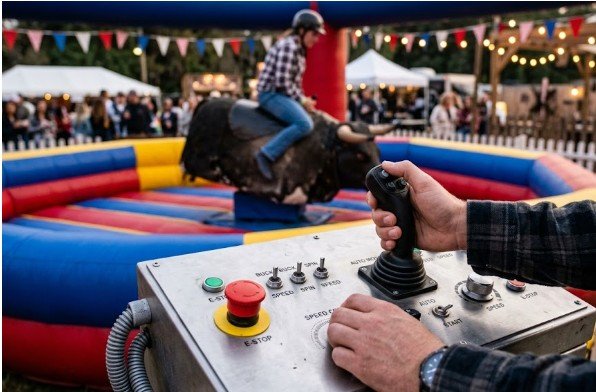
The operator must also understand the Mechanical bull controls because speed, spin, bucking motion, and emergency stopping affect rider suitability. Even an eligible rider should start at a low, controlled setting.
Rental Company and Insurance Rules
Rental companies may impose stricter rules than the manufacturer. Their insurer may require a higher minimum age, signed waivers, adult consent, sobriety rules, or reduced speeds for younger riders.
An insurance application published for mechanical bull operators asks what speed is used for minors and states that children under ten should not exceed a specified setting. This illustrates how operating speed can form part of an insurer’s risk controls.
Therefore, meeting the machine’s capacity does not guarantee permission to ride. The operator’s approved policy still applies.
State and Local Regulations
Amusement-device oversight differs across the United States. Permits, inspections, operator qualifications, and adopted technical standards can vary by state or municipality.
Oklahoma’s administrative guidance, for example, states that mechanical bulls and similar devices must meet applicable ASTM requirements. Event organizers should ask the rental provider who handles permits and inspections instead of assuming none are needed.
How I Check Whether Someone Can Ride
I use a three-gate test when reviewing mechanical bull age and weight requirements. A rider should pass all three gates, not just one.
The Three-Gate Rider Test
Gate one is equipment eligibility. The rider must meet the manufacturer’s documented height and weight limits.
Gate two is operator eligibility. The rider must satisfy the rental company, insurer, waiver, and event rules.
Gate three is personal suitability. The rider must be able to mount, sit securely, follow directions, and understand when to stop.
Failure at any gate means the person should not ride. This method is more reliable than using age as the only screening tool.
A Worked Rider Example
Consider a nine-year-old who weighs 75 pounds but stands 45 inches tall. The child passes a hypothetical age rule and remains far below the weight limit. However, the child fails a 48-inch manufacturer requirement.
Now consider a healthy adult who stands six feet tall and weighs 285 pounds. That rider may qualify on a 300-pound commercial model but not on a smaller unit capped at 250 pounds.
These examples show why one number cannot answer the whole question.
Safety Rules Beyond Age and Weight
Eligibility does not remove the possibility of injury. Published medical literature has reported serious pediatric injuries connected with mechanical bull riding and has called for stronger precautions.
Health Restrictions
Pregnant guests should not ride. People with neck, back, joint, bone, balance, heart, or recent surgical concerns should also stay off unless medically cleared.
Anyone who feels dizzy, unwell, intoxicated, or unable to follow instructions should not participate. The operator should have authority to refuse a ride without debate.
Clothing, Shoes, and Loose Items
Operators commonly require riders to remove shoes, glasses, phones, keys, and loose jewelry. Scarves, unsecured belts, and dangling accessories may catch or become projectiles.
Riders should wear fitted clothing that permits movement. One rider should use the bull at a time. Tandem riding should never be allowed.
Waivers and Adult Supervision
Adults commonly sign their own waivers. A parent or legal guardian usually signs for a minor. A waiver explains risk but does not replace proper maintenance, supervision, or operation.
Children should remain with a responsible adult while waiting. Spectators must stay outside the inflatable landing area and away from the controls.
Questions to Ask Before Booking
Before paying a deposit, I would ask for the exact minimum age, minimum height, and maximum weight. I would also request the bull’s model-specific operating limits.
Confirm that a trained operator remains present throughout the event. Ask about insurance, inspections, waivers, weather restrictions, emergency stopping, and rules for children.
Get the answers in writing. The written contract should match the rules communicated to guests. If the provider cannot explain its mechanical bull age and weight requirements, choose another company.
FAQs
1. What is the minimum age for riding a mechanical bull?
Many operators set the minimum between five and ten years, but the manufacturer, insurer, venue, and rental company determine the actual limit.
2. What is the usual mechanical bull weight limit?
Full-size commercial machines commonly allow 250 to 300 pounds, while compact or children’s units may have a much lower capacity.
3. How tall must a child be to ride a mechanical bull?
Some commercial models require a minimum height of 48 inches, although the operator must confirm the rule for the exact machine.
4. Can adults over 300 pounds ride a mechanical bull?
Not on a machine capped at 300 pounds. The rider must use a model specifically rated and insured for their weight.
Saddle Up Smart, Not Sorry
Safe participation starts with the machine manual, not a general number found online. Check the operator’s written policy, confirm the rider’s height and weight eligibility, and consider their health and ability to follow instructions.
My clearest takeaway is simple: mechanical bull age and weight requirements work as a combined screening system. Confirm every limit before the event, post the rules clearly, and let the trained operator make the final call.