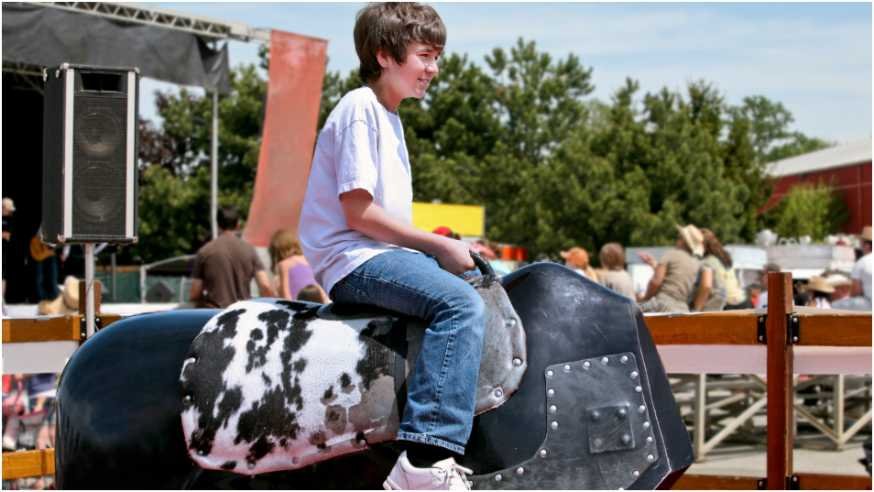
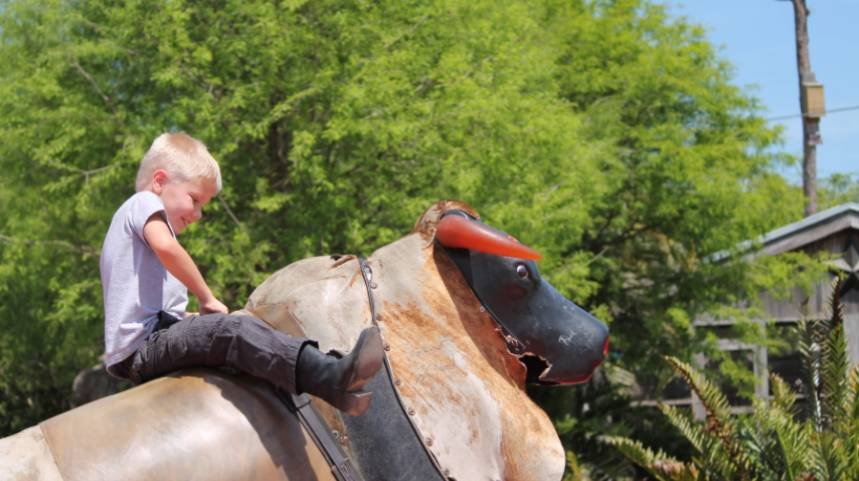
The fastest way to lose your seat is to fight every movement with stiff arms and tense shoulders. Learning how to balance on a mechanical bull starts with a different approach: grip firmly below the waist while keeping everything above it loose and responsive.
When I study successful rides, I notice that balance rarely comes from raw strength. It comes from staying centered, anticipating movement, and making small corrections before a larger correction becomes necessary.
Why Mechanical Bull Balance Feels So Difficult
A mechanical bull can pitch, turn, rise, drop, and change direction within seconds. Your body must respond to several forces without losing its connection to the saddle.
Many beginners pull hard on the handle when they feel unstable. That reaction may feel secure, but it often stiffens the shoulders and shifts the rider away from the center.
The goal is not to remain perfectly still. Good riders move constantly. They allow their hips and torso to absorb the motion while their thighs maintain a secure lower-body anchor.
Falls also deserve serious attention. A study of mechanical bull injuries treated in US emergency departments estimated 27,903 injuries between 2000 and 2020. Falling or being thrown caused most cases, while sprains, fractures, and upper-extremity injuries appeared frequently.
Build a Strong Lower-Body Anchor
Understanding how to balance on a mechanical bull begins with your legs. Your thighs should hold you in position so your gripping arm does not carry your entire body weight.
Squeeze With Your Thighs
Press your inner thighs firmly against the bull. Maintain steady pressure rather than squeezing only when the ride becomes difficult.
Think of your lower body as the roots of a tree. Your torso can sway, but your base must remain connected.
Avoid locking your knees. A locked leg cannot absorb movement effectively. Keep a slight bend that allows your hips and knees to react together.
Keep Your Feet Forward
Move your lower legs slightly forward instead of letting them trail behind you. Turn your heels gently inward when the bull’s shape allows it.
This position helps your thighs maintain contact. It also reduces the chance of your legs swinging outward during a spin.
Do not hook your feet into unsafe gaps or wrap your legs around equipment. Follow the operator’s instructions and use only the intended riding position.
Use the Correct Mechanical Bull Riding Posture
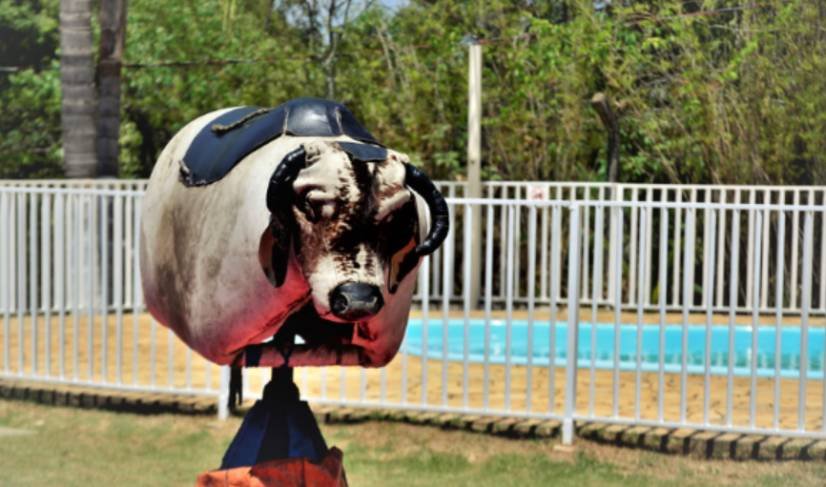
Your starting position affects every movement that follows. A poor setup forces you to make large corrections as soon as the bull begins moving.
Sit Close to the Center
Place your weight over the middle of the bull rather than leaning far forward or sitting heavily near the rear.
Keep your hips beneath your shoulders. Your head, chest, and pelvis should begin in a roughly vertical line.
I recommend checking your position before the ride starts. Ask yourself whether you could lift your gripping shoulder without falling sideways. If not, you may already be leaning too far.
Keep Your Upper Body Loose
Relaxed does not mean weak. Keep your core active, but allow your shoulders and spine to move.
A stiff torso behaves like a rigid board. When the bull changes direction, the whole board tips. A flexible torso behaves more like a spring and absorbs part of the movement.
Breathe normally. Holding your breath can increase tension and slow your reactions.
Turn Your Free Arm Into a Counterweight
Hold the handle firmly with your dominant hand unless the operator advises another position. Test both an underhand and overhand grip before starting, then choose the position that feels secure without straining your wrist.
Raise your free arm above shoulder height. Keep the elbow slightly bent and the hand open.
Move that arm opposite the direction of your falling weight. If the bull pulls your body toward the right, move your free arm toward the left. This action creates a counterweight and helps return your chest toward the center.
Do not wave the arm randomly. Controlled movement works better than large, frantic swings.
These principles also support broader Mechanical bull riding tips, especially those involving posture, grip, reaction timing, and safe dismounts.
Move With the Bull Instead of Fighting It
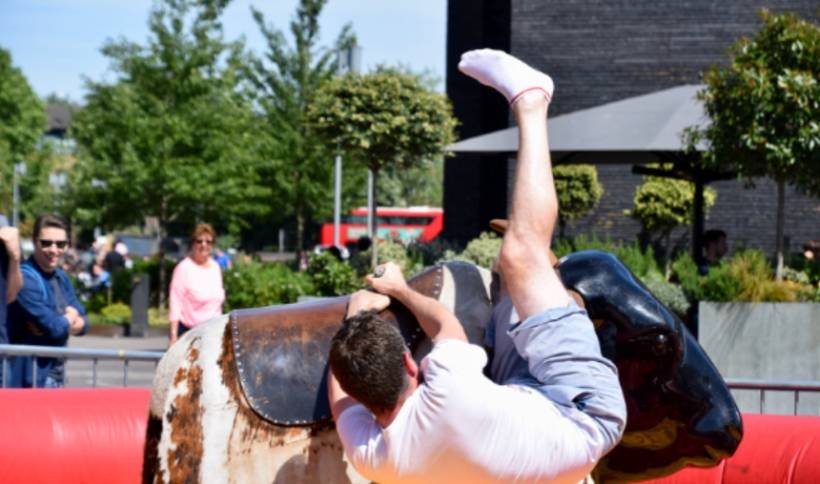
The core skill behind how to balance on a mechanical bull is matching your response to the bull’s motion. I think of the rider and bull as opposite ends of a seesaw.
Respond When the Bull Dips
When the bull’s head drops, your upper body naturally wants to continue forward. Shift your shoulders slightly backward and keep your chest lifted.
Do not make a dramatic backward lean. A small movement is usually enough when performed early.
Keep squeezing with your thighs. Pulling only with your arm may twist your shoulder and place too much weight on the handle.
Respond When the Bull Rises
When the front rises, move your chest slightly forward and drive your hips toward the bull’s shoulders.
This adjustment prevents your seat from sliding toward the back. Keep your chin level rather than looking upward.
Imagine keeping your belt buckle connected to the bull. Your hips should follow the rise before your shoulders fall behind.
Adjust During Spins
During a turn, keep your chest facing toward the bull’s head as much as possible. Allow your hips to rotate while your free arm balances the outside pull.
Avoid staring at the room. Watching the surroundings spin can make you feel disoriented and delay your next correction.
Make several small adjustments rather than one dramatic lean. Small corrections preserve your center and use less energy.
Watch the Bull’s Head to Improve Reaction Time
Your eyes guide your balance. Look toward the bull’s head or the area just behind it.
The head often shows the beginning of a pitch or directional change before the rest of your body feels the full movement. This gives you a brief chance to prepare.
Looking at the floor can pull your head and shoulders downward. Watching the crowd may turn your torso away from the riding position.
To improve how to balance on a mechanical bull, keep your gaze steady and let peripheral vision track the surrounding area.
Beyond the ride itself, mechanical bulls can become social media friendly attractions because the movement, rider reactions, and crowd energy naturally create memorable photo and video moments.
Use My Three-Second Balance Reset
I use a simple mental check to evaluate a rider’s position: knees, hips, hand.
First, check that your knees remain soft and close to the bull. Next, bring your hips back over the center. Finally, raise your free hand and move it opposite your shifting weight.
This three-part reset can happen in about three seconds during a slow section of the ride.
For example, imagine that a clockwise spin pulls your hips left. Squeeze your thighs, shift your hips slightly right, and extend your free arm right. Once centered, relax the shoulder again.
The key is correcting the hips before making a large upper-body movement.
Common Mechanical Bull Balance Mistakes
The most common mistake is trying to hang from the handle. Your hand should support your position, but it should not replace your legs and hips.
Beginners also lean too far in anticipation of the next movement. Guessing aggressively can place you off-center before the bull changes direction.
Other frequent problems include staring at the floor, holding the breath, locking the knees, lowering the free arm, and riding at excessive speed too soon.
Do not place your free hand on the bull. It cannot function as a counterweight there, and it may create an unsafe arm position during a fall.
Practice Safely Before Increasing the Speed
Ask the operator to begin slowly. Use the first part of the ride to test your grip, posture, and ability to respond to basic pitches.
Only increase the speed when you can remain centered without hanging from the handle. A skilled operator should control the ride according to the rider’s ability and stop it when necessary.
ASTM’s amusement ride standards address areas such as operation, maintenance, inspection, manufacturing, and design. IAAPA also identifies trained operators, inspections, operating procedures, and guest safety protocols as central parts of responsible ride operation.
Ride only when the surrounding inflatable or padded area is fully set up. Remove loose objects from your pockets and follow posted age, height, health, clothing, and footwear requirements.
Avoid riding while impaired. Stop immediately if you feel pain, dizziness, numbness, or unusual discomfort.
Frequently Asked Questions
1. How do beginners stay balanced on a mechanical bull?
Beginners should squeeze with their thighs, sit centrally, keep their upper body loose, and use the free arm as a counterweight.
2. Should I lean forward or backward on a mechanical bull?
Lean slightly backward when the head drops and slightly forward when the front rises, using small movements rather than dramatic shifts.
3. Where should I look while riding a mechanical bull?
Look toward the bull’s head because it helps you anticipate pitches, turns, and changes in direction.
4. Does upper-body strength help with how to balance on a mechanical bull?
Some grip strength helps, but posture, thigh pressure, hip movement, timing, and relaxation matter more than pulling power.
Stay Loose, Look Sharp, Ride Longer
Once I understood how to balance on a mechanical bull as a coordination skill, the technique became much clearer. The legs create the anchor, the hips follow the machine, and the free arm brings the body back toward center.
Start at a controlled speed and practice one correction at a time. Squeeze with your thighs, watch the bull’s head, and keep your shoulders loose. The rider who reacts smoothly usually lasts longer than the rider who simply holds tighter.